Dental Emergency Every Saturday

Do you need urgent dental care on the weekend? We are here for you! Our practice on Eliška offers dental emergency services every Saturday to help you in cases of pain, swelling, or other urgent dental issues.

We treat both our registered patients and new clients who require fast assistance.

If you couldn't find a suitable appointment online, please don't hesitate to contact us. We will be happy to help you schedule a visit.

Periodontology

Periodontology

Periodontology – treatment of gums and periodontitis. Preserve your teeth and healthy gums with timely care. Periodontology is a specialized field of dentistry that focuses on the prevention, diagnosis, and treatment of diseases affecting the supporting structures of teeth – namely the gums, periodontal tissues, and surrounding bone structures of the jaw. One of the most common diseases is periodontitis (commonly known as “periodontal disease”), which affects up to half of the adult population. This inflammatory gum disease can lead to tooth loss if left untreated.

Stages of Periodontitis Treatment

At Smile Centrum Prague, we offer comprehensive periodontal care that takes place in three phases:

Initial Therapy – Eliminating the Cause of Inflammation

  • Professional dental hygiene – removal of tartar, plaque, and pigments
  • Treatment of gum inflammation
  • Education on proper tooth brushing technique and interdental cleaning methods
  • Use of antibacterial mouthwashes and possibly local antibiotic therapy

Deep Scaling and Root Planing (Subgingival Cleaning)

  • Performed when deeper structures are affected
  • Mechanical removal of inflammatory deposits beneath the gums
  • Helps to stop bone loss and strengthen tooth attachment
  • Price: from 350 CZK per tooth

Advanced (Surgical) Treatment – for Severe Periodontitis

  • Surgical opening of the gums and treatment of deep periodontal pockets/ defects
  • Bone tissue regeneration (augmentation)
  • In cases with significant tissue loss, soft tissue grafting can be used

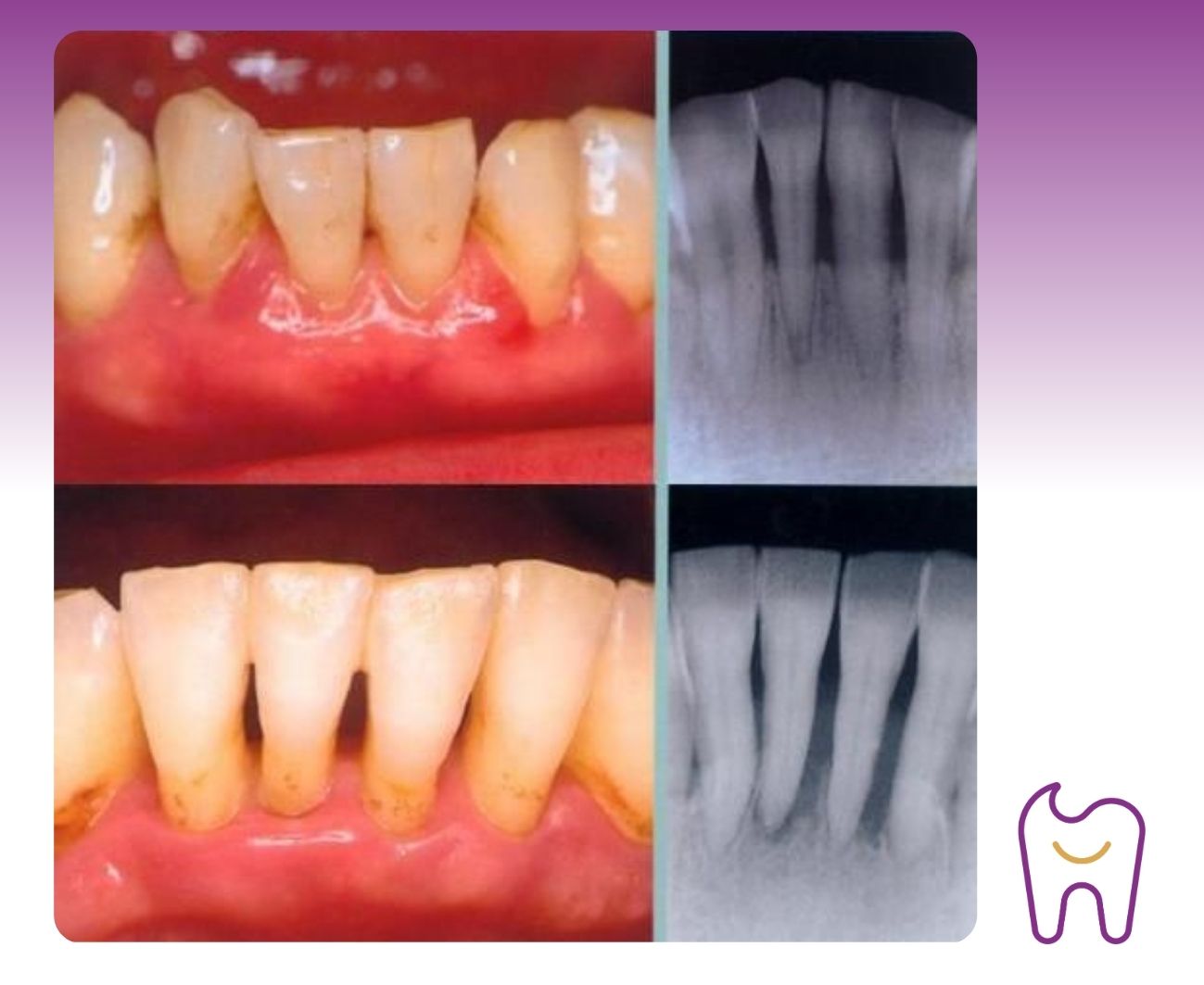
Our Work – Before & After

treatment of gums and periodontitis

    What is Periodontitis and How Does it Develop?

    Periodontitis is a chronic inflammation that develops due to the accumulation of plaque and tartar at the junction between the tooth and gums. Plaque contains bacteria that cause gum inflammation, known as gingivitis. If left untreated, the inflammation progresses deeper – leading to ligament breakdown, loss of tooth attachment in the socket, and bone loss in the jaw.

    The main symptoms include:

    bleeding gums during brushing
    swollen, red, or receding gums
    bad breath (halitosis)
    loose teeth
    pain or sensitivity of the gums
    increasing spaces between teeth

    Without timely treatment, it can lead to tooth loss, even in otherwise healthy individuals.

    Prevention is Key

    regular dental hygiene appointments (every 3-6 months)
    periodontal status check-up
    thorough home care
    proper cleaning of the gingival margin/pocket
    professional teeth whitening only after stabilization of the condition
    Guarantee

    Guarantee

    A guarantee of quality and pain-free treatment

    Top-tier equipment

    Top-tier equipment

    Advanced equipment for superior care
    Comprehensive Care

    Comprehensive Care

    Comprehensive care for our patients

    Opening Hours

    Opening Hours

    Extended opening hours including Saturdays

    Contracts

    Contracts

    Contracts with health insurance providers

    Dental laboratory

    Dental laboratory

    Our own modern dental laboratory

    Location

    Location

    Excellent transport accessibility

    Reception Services

    Reception Services

    A pleasant and calm environment
    Languages

    Languages

    We speak more than five languages
    Availability

    Availability

    We have short waiting times for appointments

    Our team

    Dentist
    Accepting patients
    CSUKEN

    Who is at Risk for Periodontitis?

    Periodontitis most commonly occurs in adults over the age of 35, but it can also affect younger individuals. Risk factors include:

    poor oral hygiene.
    smoking.
    genetic predisposition.
    diabetes.
    chronic stress.
    vitamin deficiencies (especially C and D).
    untreated tooth decay or poorly executed prosthetics.
    irregular visits to the dentist and dental hygienist.

    7 Effective Periodontitis Treatment Methods

    Improved oral hygiene – proper brushing technique, using interdental brushes.
    Professional dental hygiene – removal of tartar and plaque.
    Antibiotic therapy – as recommended by your doctor.
    Surgical procedures – scaling and root planing, access to deeper pockets.
    Healthy lifestyle – diet rich in vitamins, limiting sugar intake.
    Quitting smoking – essential for treatment success.
    Stress reduction – positive impact on the immune system.

    Prices for Initial Examination

    Administrative Fees

    Valid from:
    ProcedureDetailsPrice
    Administrative Fee / Medical Record Extract550 Kč
    Missed or Cancelled Appointment (per 30 minutes)950 Kč
    Initial Examination including Panoramic X-rayCovered by Health Insurance
    Preventive Check-up 2x per yearCovered by Health Insurance
    Initial Examination for Uninsured Patients / Not Covered by Health Insurance1950 Kč
    Emergency Fee for Uninsured Patients / Not Covered by Health Insurance950 Kč

    X-ray – Examination

    Valid from:
    ProcedureDetailsPrice
    Evaluation of OPG and X-rayCovered by Health Insurance
    Intraoral X-ray (for private patients) – Taking + Evaluation250 Kč
    OPG X-ray (for private patients) – Taking + Evaluation890 Kč
    CBCT scan quadrant1190 Kč
    CBCT scan 1 jaw1490 Kč
    CBCT scan1790 Kč
    (*) price including 21% VAT

    Indications and Contraindications for Periodontal Treatment

    Periodontology focuses on the prevention, diagnosis, and treatment of gum disease and the supporting tissues of the teeth (the periodontium). Its goal is to maintain the health and stability of teeth in the bone. Here you will find an overview of situations where periodontal treatment is appropriate, and when it may be necessary to consider alternative procedures or postpone treatment temporarily.

    Indications (When is treatment recommended?)

    1. Bleeding gums

    The most common and first sign of gum inflammation (gingivitis), often during brushing or spontaneously.

    2. Red, swollen, or tender gums

    Signs of inflammation that can progress to more severe periodontitis.

    3. Bad breath (halitosis)

    Often caused by bacteria in periodontal pockets and gum inflammation.

    4. Gum recession

    Exposed tooth roots that can cause sensitivity and threaten tooth stability.

    5. Tooth mobility (increased looseness)

    A sign of advanced periodontitis with bone loss around the teeth.

    6. Changes in tooth position, spacing between teeth

    Tooth migration or spacing between teeth, often caused by weakening of the supporting tissues.

    7. Periodontal pockets

    Increased space between the tooth and gum where bacteria accumulate and bone loss occurs.

    8. Diabetes mellitus (diabetes)

    Patients with diabetes are at higher risk of periodontitis and require specialized periodontal care.

    9. Smoking

    Smoking is a significant risk factor for the development and progression of periodontitis.

    10. Genetic predisposition

    A family history of periodontitis increases the risk and requires careful prevention.

    11. Pre-prosthetic preparation (preparing for dentures, implants, etc.)

    Healthy gums and periodontium are essential before fabricating crowns, bridges or implants.

    Contraindications (When is caution needed?)

    1. Acute systemic infection

    Feverish conditions (flu, sore throat), severe cold, cough or other acute infections that could endanger both you and the staff.

    2. Acute uncontrolled abscess

    Severe acute inflammation or purulent infection (abscess) in the oral cavity that requires immediate treatment and stabilization of the condition first.

    3. Uncontrolled systemic diseases

    Very unstable diabetes, uncontrolled high blood pressure, serious heart conditions, recent myocardial infarction, uncontrolled bleeding disorder. Requires consultation with the attending physician and possible premedication.

    4. Radiation therapy or chemotherapy in the head and neck area

    Depending on the stage and extent of treatment, it may be necessary to postpone treatment or proceed with extreme caution after consultation with the attending oncologist.

    5. Allergies to materials used or local anesthetics

    Known allergy to local anesthetics, antiseptics or other substances used in periodontal procedures.

    6. Pregnancy (relative contraindication)

    It is recommended to postpone non-urgent procedures in the first trimester. Essential treatment can be performed in the second trimester, ideally with consideration for minimal stress. Consultation with a gynecologist is always advisable.

    7. Severe immunosuppression

    For example, in patients after transplantation or with autoimmune diseases who are taking immunosuppressants – higher risk of infection and impaired healing.

    8. Patient’s mental or physical limitations

    If the patient is unable to cooperate or follow postoperative instructions, which could jeopardize the success of treatment.

    Important note: This list is for informational purposes only. Each periodontal case is unique and requires careful individual assessment by a specialist. It is always crucial to inform your dentist or periodontist of your complete medical history and current health status so they can choose the safest and most effective treatment plan.

    Periodontitis FAQ

    What is the main cause of periodontitis?

    The most common cause is accumulated plaque and tartar, poor oral hygiene and neglect of preventive check-ups.

    Is periodontitis hereditary?

    No. A predisposition can be hereditary, but the disease itself arises due to insufficient dental and gum care. It can be completely prevented with prevention.

    My gums bleed – do I have periodontitis?

    Bleeding gums can be a symptom of early gingivitis. We recommend visiting a dental hygienist or dentist for an examination as soon as possible.

    How long does periodontitis treatment take?

    The length of treatment is individual. Expect several visits during the first 3 months and subsequent regular check-ups and hygiene appointments.

    Can periodontitis lead to tooth loss?

    Yes, advanced periodontitis causes loss of bone support for the teeth and their looseness. Early treatment will stop this process.

    Is it possible to undergo teeth whitening if I have gum problems or periodontitis?

    Teeth whitening is only possible after stabilization of gum inflammation and successful treatment of periodontitis. If you suffer from bleeding, swelling or other signs of inflammation, it is first necessary to undergo professional dental hygiene and treatment of periodontal tissues. Healthy gums are the basis for every aesthetic procedure including teeth whitening.

    Hodnocení Smile Centrum

    Doporučuje nás 92% našich pacientů, kteří zanechávají recenze na nezávislých portálech a sociálních sítích. Klinika je nemůže
    ovlivnit, a proto jsou pro nás tak cenné.

    Google
    4,9

    ★★★★★

    Seznam
    4,9

    ★★★★★

    WhatClinic
    5,0

    ★★★★★

    Bookimed
    5,0

    ★★★★★

    Google
    4,9

    ★★★★★

    Seznam
    4,9

    ★★★★★

    WhatClinic
    5,0

    ★★★★★

    Bookimed
    5,0

    ★★★★★